Routine maintenance at Jackson Bottom Wetlands demonstrates how reliable wastewater systems and healthy ecosystems can thrive together
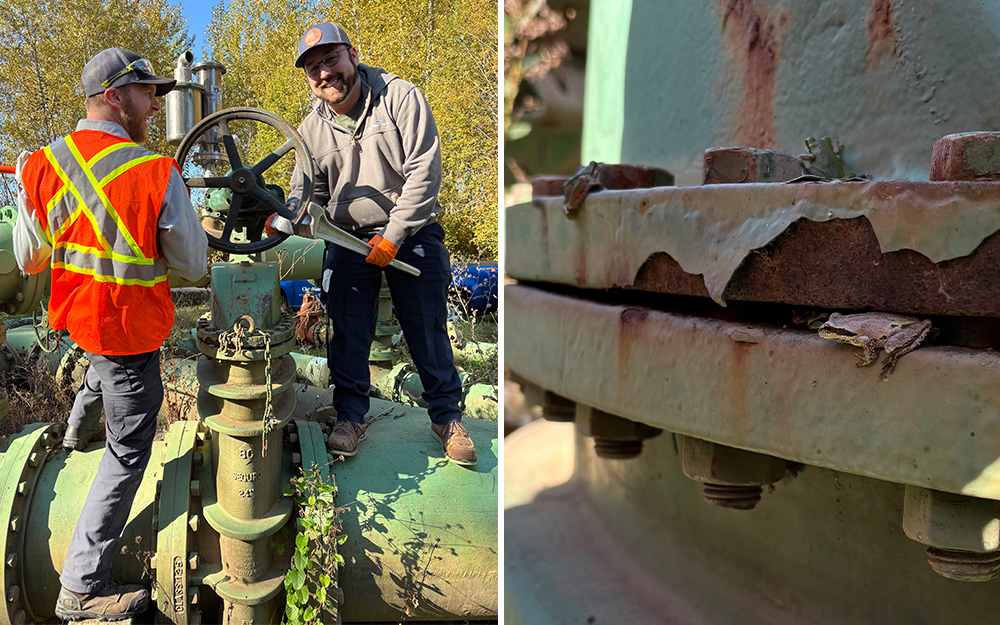
Your ratepayer-funded sewer and stormwater infrastructure helps keep the Tualatin River Watershed habitable, and sometimes it becomes actual habitat. Operators from our Rock Creek treatment facility recently discovered they were being supervised by more than a dozen frogs during a routine maintenance check of a valve system in Jackson Bottoms Wetlands.
The valve tree — an attractive seasonal amphibian abode because most of it is completely underwater during the winter months or after heavy rain — is also an important intersection of infrastructure responsible for carrying between 10 to 14 million gallons of wastewater a day from homes and businesses across in the western part of urban Washington County for treatment.
Depending on where you live in the Tualatin River Watershed, your wastewater may need to pass through more than one Clean Water Services treatment facility, and the valve tree at Jackson Bottoms Wetlands helps make that movement possible.
After we separate solids from wastewater during the treatment process at the smaller Hillsboro and Forest Grove facilities, those solids commute to the larger Rock Creek facility for further treatment. In the summer, wastewater from the Hillsboro facility heads to Forest Grove to help maintain Hillsboro’s treatment capacity and increase to the amount of water that enters the Fernhill Natural Treatment System after going through the conventional treatment process at the Forest Grove facility. During the wetter winter months, flows that are too much for the small Hillsboro facility go to Forest Grove or Rock Creek.
Without this interconnected system, the risk of sanitary sewer overflows would increase and maintaining water levels at Fernhill during the dry summer months would be more challenging.
Maintaining and Improving Systems
Like all of the sewer and stormwater infrastructure that protects humans and wildlife, the valve system at Jackson Bottom Wetlands requires regular maintenance and upgrades — with or without amphibian supervision.
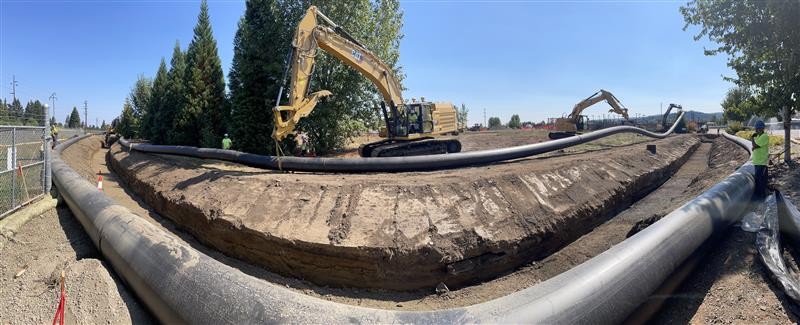
The maintenance side includes Clean Water Services operators frequently checking and “exercising” the valves (opening and closing or closing and reopening) to prevent them from getting stuck or rusting over. Our field operations crews also recently upgraded a pipeline connected to this valve system by replacing about 1200 feet of pipe near Forest Grove.
As Clean Water Services plans for the growing and changing needs of the communities we serve, more changes could come to the valve system. As outlined in our Capital Improvement Plan for 2026 through 2030, we intend to build a new solids treatment system at the Forest Grove facility. This would save capacity at Rock Creek and open up the pipelines connected to the valve system for other purposes — such as recycled water, irrigation, and emergency conveyance.
Maintaining and improving the valve tree requires coordination across multiple teams. Conveyance engineers plan long-term upgrades; field operations crews perform routine monitoring, cleaning, and repairs; and treatment plant operators carry out annual inspections and valve exercises, occasionally under the watchful eyes of a few native frogs.
The systems that protect public health often operate alongside wetlands, streams, wildlife, and other natural resources. Wildlife thriving around this infrastructure is a reminder of how considering and caring for both built and natural systems can benefit our ecosystems as well as our communities.